Translate

Showing posts with label A-TSI School Plan. Show all posts

Monday, June 24, 2019

The Illusion of Community Engagement in CASD's Improvement Plan


Earlier today, we posted an overview of the concerns compiled by Amelia Mills regarding CASD's A-TSI plan, including the comparison with a plan from another district that exemplified the lack of specificity in our plan. In this follow up, we wanted to share the experiences of multiple parents who attended the single one-hour community meeting Rita Perez held for the purpose of obtaining community input. It is our contention, based on the lack of notice given for this meeting, the lack of outreach for participation in this meeting, and the fact that this was the only meeting held with community members for the A-Tsi plan, that the administration had no true desire to include the community's feedback. This was just one more example of providing an illusion of community engagement as a way to check the box on this topic.

Kim Winkler, one of the parents who attended the meeting after being invited just hours ahead of time, wrote down her notes about the meeting on the same night:

Teachers and administrators discussed how we can meet our projected goals next year.  We were broken off into groups (elementary, middle, high school) and I had Kim Donahue, Assistant to the Superintendent, as our group's “leader.” Only Tommy [Kim's husband], myself, and two other parents were there with Heather Messenger and Allison Shimon, both assistant principals for district middle schools. 

The other two parents spoke about the expectation levels being completely different for each of their children and as the years have passed that expectations and the push for them to excel has diminished. Donahue kept saying it’s the teachers who need to deliver each lesson to engage all students and need to accommodate lesson plans to meet all different levels of learners in their class.

Angrily, when I had the opportunity, I questioned how teachers could be expected to do that. When I was teaching in my classroom, which was labeled as an autistic classroom, I had students who were in wheelchairs with feeding tubes, unable to see or hear, and other students high on the spectrum.  It is impossible for a single teacher to have one lesson to reach all students' needs.  Not to mention the fact that yes, a lesson plan is good in theory, but there are so many outside factors that play a role in that lesson not being able to be delivered.   Behaviors, students on a 2nd grade reading level in 7th grade, and kids who are excelling and need to be challenged with extra educational material.  Additionally, students with IEP’s don’t have the support they need either.

Immediately, Kim Donahue became defensive and said students who need extra help in math or English are pulled to have instructional time with special education teachers, and I have inclusion all wrong.   She said ALL IEPs are being followed and data supports homogeneous classrooms.  She conceded that she wasn't familiar with my situation, but she attested that my concerns were not district-wide and only seemed relevant to my situation. She suggested that I don’t understand what is truly happening.  One of the other parents spoke up and agreed with me.

Before discussion could continue, Rita rang a timer and started to speak. “Thank you all for attending; we greatly appreciate everyone’s input and time. If we could have one person speak up per table to communicate what was spoken about."

Alison Shimon spoke for our middle school table and said we only had time to discuss the objective goals for math and ELA and there were many concerns.  Some parents shared concern with expectation levels decreasing, and one parent, who is an alumni of South herself, has several questions that are very relevant and not being answered. She stated that parents need to be informed about what is going on and that is not happening.  She admitted that the goals in the plan are possibly too difficult to achieve. She also shared that she hoped that more detailed time and input would take place prior to submission.

Rita thanked us for our time, and said she presumed that we wanted to get out and continue enjoying the beautiful weather for the night. She requested all documents be returned and it was frowned on that I wrote notes on my handout.

My conclusion is that it was very unproductive. Kim Donahue gave the impression she was not interested in hearing anything we said. She simply wanted to defend the district's actions.


Jane Ventrella also shared her thoughts  with us regarding her experience:

When I think of my recent experiences with the school district at the administration level, the word that comes to mind is “discord”. What I mean is this: what is stated as truth in various methods of district communication is at odds with the reality of what I experience as a parent.

As an example, I recently attended a meeting with administrators and other parents, the topic being the school improvement plan. There was a set agenda of goals and objectives. When I review the outcome of that meeting (posted on the CASD district website), I see none of the specific input that was shared during that meeting. Why have the meeting if you aren’t really going to incorporate the feedback that was shared? That’s not community engagement.

And that’s really at the heart of it all: we are given lip service. We read and hear many communications indicating “don’t worry, we have a plan, all is well”. But the reality is very different. Whether it is the timing of the communication or the content, constantly being told “you are wrong, all is well” when there are hard facts to support our concerns, nothing is done to alleviate those concerns. In fact, it validates the suspicion that our children are not in good hands and that leadership needs to change.

Coatesville's A-TSI School Plan

This article is a collaboration among several CAP members including
Amelia Mills, West Caln, Candidate for SB Region 3, Retired Educator, Retired CASD employee.

During the June Education Committee meeting CASD Leadership presented their “A-TSI School Plans.” Earlier this year FIVE schools in the Coatesville Area School District were designated as A-TSI (Targeted School Improvement). 

CASD’s (documented) Plans for School Improvement - by Amelia

I read the published plans with great interest to see exactly what CASD plans to do to support our schools needing improvement.  So I was happy to see that our TSI plans show that the five schools will once again use school-wide benchmark testing and data driven-instruction. In the past CASD was highly successful with targeting instruction for students who lagged behind academically by using data, provided by PSSA’s annual assessment, along with quarterly benchmarks and teacher-designed formative assessments.

I was saddened and surprised that our district didn’t use this opportunity to do something new, something innovative with programming. Instead the improvement plans focus on the same-old same-old including Co-teaching, which we know is not currently implemented with fidelity. Only one CASD school is targeted for school improvement due to lack of academic improvement of our students with disabilities, I believe this is due to the hard work and wisdom of our veteran teachers who have been successfully differentiating instruction for years. It is not a result of the poorly implemented co-teaching model that CASD currently uses.

In addition, CASD’s A-TSI school plans mirrored the same questionable programs and initiatives described in CASD’s Comprehensive Plan: Equity Leadership Program, Mindfulness, Positive Behavior Supports, Units of Study and College Preparatory Math.

How does CASD (verbally) explain and position Targeted School Improvement?

After reading the details of their school plans, I was eager to hear first-hand what district leadership’s would present at the Education Committee meeting. This was their opportunity to apprise the school directors and the public on what CASD plans to do to improve the academic performance of the subgroups of students in our FIVE Coatesville schools.

What is CASD’s focus for school improvement as presented last Tuesday night? Fix the attendance problem. Good grief. The whole intent of A-TSI is to improve the academic performance of students.  If our District Leadership sees the fix as an attendance-fix using the same old failed programs they have been pushing since the start of the current leadership reign; I am truly frightened about the future of our district.

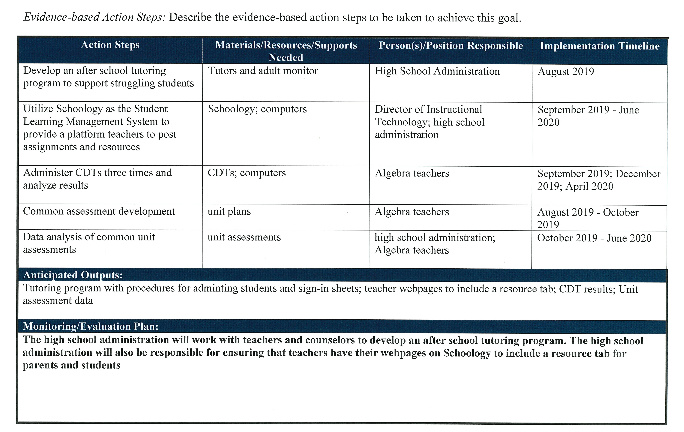
For a visual comparison and a better understanding of this plan, below is an excerpt from Coatesville and neighboring Delaware County School, Chichester. 

You'll note that Coatesville's plan is to provide professional development for all for CDT implementation, data analysis, planning for instructional changes, and data meeting protocol. None of this specifically states what we are doing to help students. Further, it specifies that DRAs will be used to measure student achievement. The DRA is a subjective test, which Audra Ritter's situation reveals, and teachers are not adequately trained to administer this test. 

What in this plan explains anything specific that will be accomplished to achieve our goal?

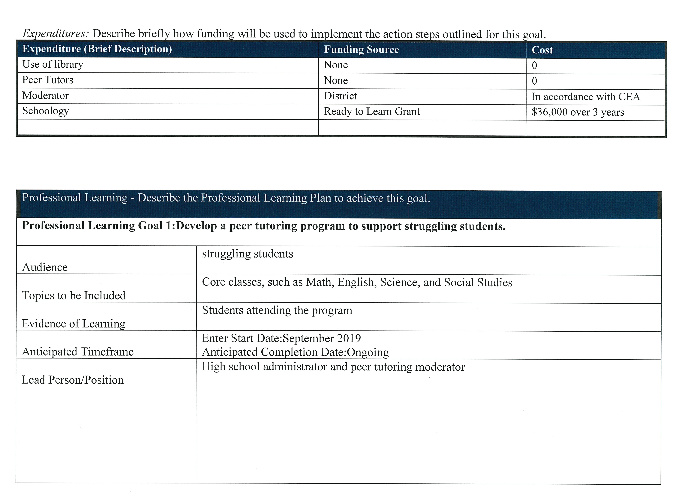
Chichester, on the other hand, not only includes the necessary training. They also include developmental steps to help students meet the goals. They allot for teachers to post specific assignments, create common assessments for specific algebra units, and include a tutoring program for students. This plan not only includes the measurement of student achievement, it also includes a plan to help them meet the achievement goal. We recognize that these could still be more specific. However, it is a better action plan towards student success.


Coatesville:
Chichester
We maintain that the board should not vote through this plan. Similar to the comprehensive plan and the special education plan, it does not represent input from the community and it does not have specific goals on HOW we will implement strategies to ensure student success. 


For anyone wanting background and context for the A-TSI:

A little historical perspective: PDE has always had initiatives to identify schools that “need improvement.” With the new ESSEA guidelines, PDE refined their approach, hence CSI and A-TSI schools. And, yes, CASD has had schools targeted for school improvement in the past. And, yes, when our schools were targeted for improvement, CASD used those opportunities to figure out what wasn’t working and change what we were doing. We were innovative, we didn’t do continue with what wasn’t working.

Pennsylvania Department of Education’s (PDE) web site gives a little background on PDE’s approach to School Improvement. Replacing No Child Left Behind, the Every Student Succeeds Act (ESSA) provides Pennsylvania with direction to designate and serve schools in need of support.

To summarize, Pennsylvania's approach to ESSA implementation "emphasizes collaboration between state and local stakeholders to identify and address root causes for existing problems, to implement appropriate and evidence-based corrective actions, and to carefully monitor the pace of improvement." 

PDE notes two designations for schools needing improvement.
  1. Comprehensive Support and Improvement (CSI): Schools facing the most significant challenges in academic achievement, student growth, and other areas; and
  2. Additional Targeted Support and Improvement (A-TSI): Schools in which performance by one or more student groups is at or below the level of the CSI schools.
How does a school get on the A- TSI List? To get on the targeted for school improvement list a school needed to have one or more subgroups of students performing badly academically.

Out of the FIVE Coatesville schools, FOUR schools need to do a better job with our children of color; THREE schools need to do better with our economically disadvantaged (our poor kids); and only one school needs to do a better job with students with disabilities.
  1. CASH = Black
  2. North = IEP, Econ Disadvantage, Black, Hispanic
  3. South = Econ Disadvantage. Black, Hispanic
  4. RB = Econ Disadvantage
  5. RCV = Black
As a matter of perspective some school districts who are also on the list, Allentown, TWO schools; Harrisburg, TWO schools; Norristown, TWO schools; Pottstown, TWO schools. And, yes Collegium is on the list.  If you are interested in seeing all 190+ school here is the full list.

I checked out the Goals for PDE’s commitment to school improvement to get a sense of what is expected of CASD.
  1. Goal: LEAS (school districts/CASD) are accountable and empowered to serve schools identified for support and improvement.
  2. Goal: Schools and communities are accountable and empowered to provide effective, engaging instruction within a supportive culture.
  3. Goal: Engaged, healthy, safe students who are college, career and community ready.
PDE’s Expectations for School Districts/CASD
  • Establish effective, standards-aligned instructional programs;
  • Support schools and their communities in removing barriers to learning;
  • Customize support systems to meet the local needs and context of individual schools;
  • Implement data-informed human capital systems; and
  • Allocate resources based on the needs of individual schools and their communities,
PDE’s expectations for schools and communities:
  • Support effective instructional practices in all classrooms;
  • Foster collective responsibility for the academic, social, emotional and behavioral outcomes of all students;
  • Cultivate a safe, positive and supportive climate that is conducive to learning; and
  • Provide high-quality professional learning opportunities for all administrators, teachers and support staff 

.